



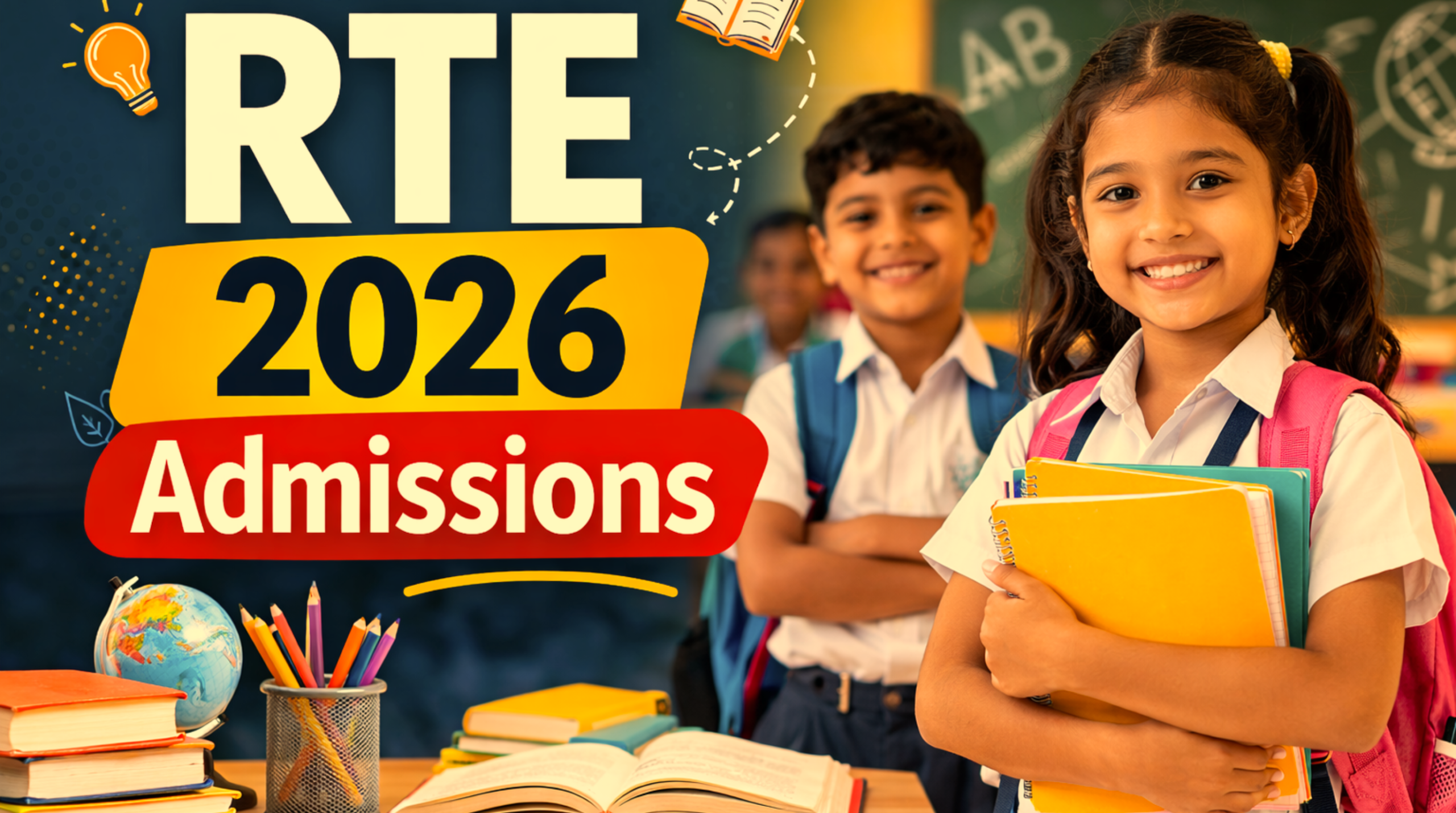
RTE 2026 Admissions: What Is Happening Now
The RTE 2026 admission process has become one of the most searched education topics as parents across India apply for free school seats under the Right to Education (RTE) Act. The scheme allows children from economically weaker sections to study in private schools without paying tuition fees.
Across multiple states, governments have opened applications, released selection lists, and conducted lottery results for the 2026–27 academic year. In Rajasthan alone, more than 6.3 lakh students applied for RTE seats, showing the growing demand for the program.
With application windows closing and lottery results being announced in several states, parents are closely following updates about seat allotment and document verification.
What Is the RTE Act and How It Works
The Right to Education Act (2009) guarantees free and compulsory education for children between 6 and 14 years of age in India. One of the most important provisions of the law requires private schools to reserve 25% of seats for children from economically weaker sections (EWS) and disadvantaged groups.
Under this system:
- Eligible children can study in private schools for free.
- The government reimburses the school for tuition fees.
- Admissions are usually conducted through an online application and lottery system.
This initiative is designed to provide equal education opportunities and reduce the gap between private and government schooling systems.
Major Updates in RTE 2026 Admissions
Several developments have made RTE 2026 admissions a major topic in education news.
1. Rajasthan RTE Lottery Result Announced
The Rajasthan education department recently announced the RTE lottery result for 2026–27, selecting students from more than 6 lakh applicants. Selected students must complete document verification before final admission confirmation.
2. Court Decision on School Distance Rule
In Maharashtra, the Bombay High Court temporarily stayed a rule limiting RTE school choices to within 1 km of a student’s home. The court said the rule could restrict access to education and asked the government to review it.
This decision allowed parents to choose schools within a larger distance range, improving opportunities for children.
3. Deadline Extension for Applications
Because of technical issues with the online portal and confusion around the rules, authorities extended the RTE application deadline in some districts so parents could complete their applications.
RTE 2026 Admission Eligibility
To apply for RTE admission in 2026, children must meet specific eligibility requirements.
Age Criteria
Children applying for Class 1 should generally be around 6 years old by December 31, 2026.
Income Category
Families must belong to:
- Economically Weaker Section (EWS)
- Disadvantaged groups such as SC/ST or other eligible categories.
Residential Requirement
Applicants must live within the designated neighborhood distance from the school.
These criteria may vary slightly depending on the state government guidelines.
Important Dates for RTE 2026 Admission
While dates differ by state, most RTE admission processes follow a similar timeline.
Typical timeline for the 2026 admission cycle:
- Application start: January–February 2026
- Application deadline: February–March 2026
- Lottery result announcement: March–April 2026
- Document verification: March–May 2026
- Final admission confirmation: April–June 2026
For example, in Karnataka, online applications for RTE admission will be accepted between March 16 and April 15, 2026.
Documents Required for RTE Admission
Parents applying for RTE seats usually need the following documents:
- Child’s birth certificate
- Aadhaar card
- Address proof
- Income certificate
- Caste certificate (if applicable)
- Passport-size photograph of the child
- Parent or guardian ID proof
These documents help verify eligibility during the admission process.
How to Apply for RTE 2026 Admission
The application process is now mostly digital. Parents can apply by following these steps:
- Visit the official RTE admission portal of the respective state.
- Register using a mobile number.
- Fill in the child’s details and upload required documents.
- Select nearby schools under the RTE quota.
- Submit the application form.
After the application deadline, a computerized lottery system selects students for the available seats.
Challenges Parents Are Facing in RTE Admissions
While the RTE scheme provides valuable opportunities, some parents have reported challenges such as:
- Delays in seat allotment
- Confusion regarding eligibility rules
- Technical issues on online portals
- Limited seats compared to the number of applicants
In some areas, parents have also raised concerns about children waiting for admission even after being selected in previous RTE lists.
Authorities are working to resolve these issues by improving the digital admission system and providing clearer guidelines.
Why RTE 2026 Admissions Are Important
The RTE admission process continues to play a significant role in improving education access for disadvantaged communities.
By reserving seats in private schools, the program:
- Promotes inclusive education
- Reduces inequality in schooling
- Provides quality education opportunities to underprivileged children
As awareness about the scheme grows, more families are applying every year, making the RTE admission cycle one of the most closely followed education events in India.
Conclusion
The RTE 2026 admission process is currently underway in many states, with applications, lottery results, and court decisions shaping the admission cycle. With millions of parents seeking free private school education for their children, the scheme continues to be a major step toward educational equality in India.
Parents should regularly check the official RTE portals of their state for updates on lottery results, verification dates, and final seat allotment to ensure they do not miss important deadlines.